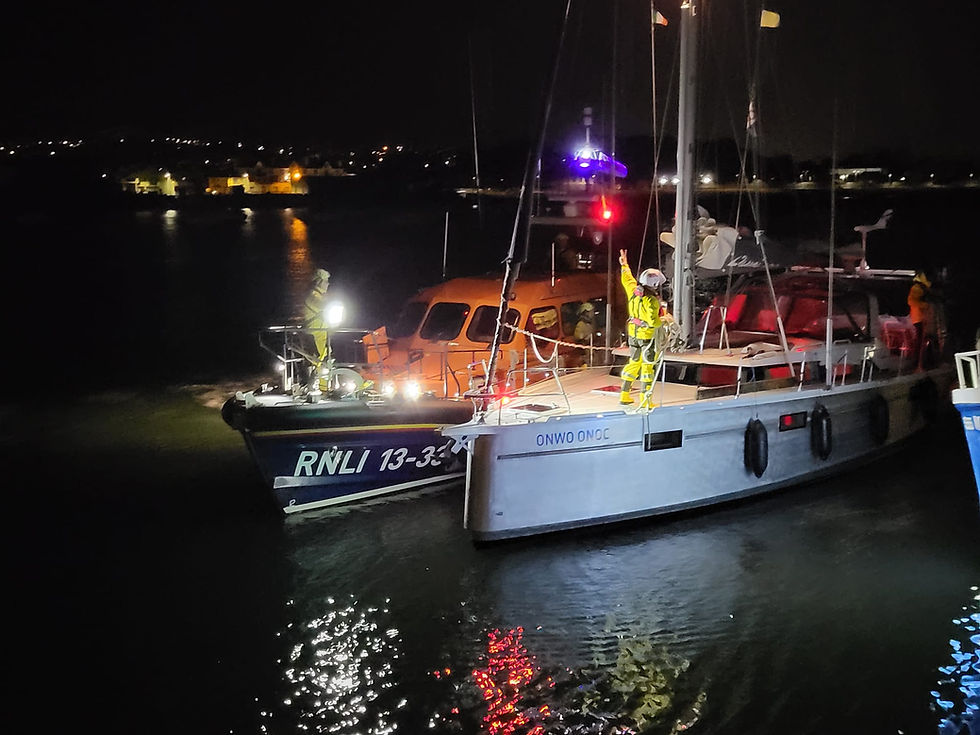
Two Sailors Rescued in Challenging Overnight RNLI Operation off County Down Coast

Monday 8 June 2026
KILKEEL, Co Down - Two sailors were rescued in separate incidents off the County Down coast during a demanding overnight search and rescue operation involving crews from Newcastle and Kilkeel RNLI late on Friday night and into the early hours of Saturday morning.

Just before midnight on Friday, 5 June, Newcastle RNLI was tasked by Belfast Coastguard after a lone sailor reported that their yacht had run aground and was taking on water on the western side of St John’s Point Lighthouse in Dundrum Bay.
Given the vessel’s location and the prevailing weather conditions, Kilkeel RNLI’s all-weather lifeboat, which had only entered operational service earlier that evening, was also requested to launch.
Newcastle RNLI launched its Atlantic 85 lifeboat at 12.13am, with Helm Locky Leneghan and crew members Caoimhe Conor, Brendan Rooney and Declan Barry making best speed towards the casualty’s last known position.
Upon arrival, crews faced difficult search conditions, including darkness, strong south to southeasterly winds and a swell of between one and one-and-a-half metres.
While the search was underway, Belfast Coastguard received a second emergency call from another lone sailor operating in the same area. The sailor reported being disorientated and unable to make way under their own power, although they were not considered to be in immediate danger.
At the same time, the first casualty activated a Personal Locator Beacon (PLB), allowing Coastguard personnel to establish a GPS position approximately 1.5 nautical miles west of the yacht’s previously reported location.
Newcastle RNLI subsequently located the yacht drifting in shallow water towards rocks near Minerstown Beach. Following a risk assessment, the helm determined that the safest option was to evacuate the sailor from the vessel.
The casualty was successfully transferred onto the lifeboat and given casualty care while being transported back to shore. Described as cold and exhausted, the sailor was handed over to the Northern Ireland Ambulance Service at Newcastle Lifeboat Station before being taken to hospital for overnight observation.
Meanwhile, Kilkeel RNLI’s new Shannon-class all-weather lifeboat, under the command of Coxswain Gerald Sharkey, was diverted to assist the second sailor.
The lifeboat crew located the yacht a short distance offshore and found the sailor to be exhausted and disorientated. With strong south-easterly winds threatening to push the vessel towards the shoreline, the crew assessed the situation and decided that the safest course of action was to place a crew member aboard the yacht and establish a tow.
Despite challenging weather and sea conditions, the operation was completed successfully, with the yacht, sailor and RNLI crew arriving safely at Kilkeel Harbour at approximately 5am.
Newcastle and Kilkeel Coastguard Rescue Teams assisted with casualty care and shoreside operations at both Newcastle Lifeboat Station and Kilkeel Harbour.
Speaking after the incident, Kilkeel RNLI Coxswain and Afloat Mechanic Gerald Sharkey praised the efforts of both lifeboat crews.
“We want to wish both sailors well following their ordeal on Friday night, into the early hours of Saturday morning. I also want to commend both lifeboat crews for a job well done in difficult conditions.
“For this to be the first call out on the Shannon which only hours earlier had officially gone on service, the crew at Kilkeel RNLI deserve great credit for how they managed and navigated the challenges they were presented with, particularly in the hours of darkness.
“This was a tough shout given the weather conditions, the fact that the yacht was so close to shore and that the casualty was tired and disorientated. The crew used their training and put their skills into action and did a fantastic job.”
The RNLI is reminding all sailors and recreational water users to ensure they carry appropriate safety equipment, including a means of calling for help and, where appropriate, a Personal Locator Beacon (PLB).
If you get into difficulty at sea, call for assistance immediately on VHF Channel 16 or dial 999 or 112 and ask for the Coastguard. Seeking help early can prevent a situation from deteriorating and allows rescue services to respond more effectively.